Who We Are
We build, test, and deliver new therapies to cure congenital heart defects, allowing families to live full, enriching lives.
Learn More

Every study moves us closer – not just by what it proves, but by what it teaches us.
To all the families who have put their trust – and their precious children – in our hands, thank you.
You are pioneers. You are our inspiration. You are helping change the future of congenital heart disease.
Because of you, we are making strides toward better treatments, better outcomes, and brighter futures.
— Tim Nelson, MD, PhD
Co-Founder & CEO, HeartWorks
HeartWorks has led and supported early-stage clinical studies to explore how cell-based therapies may support children and adults living with complex congenital heart disease.<br>These studies have focused on mononuclear cell-based therapies derived from cord blood and bone marrow. While sourced differently, these cells function in similar ways – through signaling mechanisms that may reduce inflammation and support repair within the heart.
These approaches were designed to support the heart’s environment rather than rebuild it. In doing so, they have helped establish safety, deepen our understanding of cell behavior, and build the foundation for more advanced regenerative therapies.
This work is about progress through understanding what’s possible, what’s not yet possible, and how to move forward.
Breakthrough therapies are built step by step. Our earliest clinical trials were not the final answer, they were the essential first steps.
That journey looks like this:
We began with simpler cell therapy approaches to show that cells could be safely collected, prepared, and delivered to the heart in surgical and catheter-based settings.
These early studies helped demonstrate feasibility and the absence of major long-term safety concerns in treated patients.
Mononuclear cell therapies appear to work through anti-inflammatory effects and cell signaling that may support repair. These therapies are not designed to generate new heart muscle.
What we learned is helping advance the next class of products designed to do more for the heart – such as iPSC-derived cardiac therapies, tissue constructs, and devices.
HeartWorks’ work in clinical research traces back to 2010, with a long-standing commitment to advancing new possibilities for patients with congenital heart disease.
What began as early exploration of cell-based therapies has evolved into a decade-plus effort to safely treat patients, learn from each study, and build the foundation for what comes next.
HeartWorks clinical efforts to date have focused on autologous cell therapies (patients own cells) to determine if cord blood or bone marrow mononuclear cells could improve heart function.
Expand the studies below for key takeaways.
HeartWorks-supported cord blood trials explored whether autologous umbilical cord blood mononuclear cells could be safely delivered during staged surgical care for children with single ventricle heart disease, including hypoplastic left heart syndrome.
What we learned:
Study NCT01883076 | Safety Study of Autologous Umbilical Cord Blood Cells for Treatment of Hypoplastic Left Heart Syndrome
Phase 1
Treated: 23
Controls: 3
Status: Complete, published
This early study helped demonstrate that intraoperative intramyocardial injection of autologous cord blood cells was feasible and did not raise major safety concerns.
Study NCT03779711 | Intramyocardial Injection of Autologous Umbilical Cord Blood Derived Mononuclear Cells During Surgical Repair of Hypoplastic Left Heart Syndrome
Phase 2
Treated: 50
Controls: 45
Status: Complete, published
This larger study added important efficacy and safety information. While differences in heart function were not seen at all follow-up timepoints, the trial deepened understanding of this therapy class and informed future product development.
Study NCT04907526 | Intramyocardial Injection of Autologous UCB-MNC During Fontan Surgery for SRV Dependent CHD
Phase 1
Treated: 20
Controls: 10
Status: Ongoing / not complete
This study continues to build on prior safety work while examining delivery in a later stage surgical setting.
Published Results
Autologous bone marrow-derived mononuclear cells were studied in patients with congenital heart disease to evaluate safety and feasibility.
What we learned:
No serious adverse events reported in the Phase 1 study
Mild improvements in cardiac function were observed over six months
Study NCT02549625 | Phase I Safety and Feasibility Study of Intracoronary Delivery of Autologous Bone Marrow Derived Mononuclear Cells
Phase 1
Treated: 10
Controls: 0
Status: Complete, published
This study showed that intracoronary delivery of autologous bone marrow-derived mononuclear cells could be performed without serious adverse events in this patient group.
Autologous bone marrow-derived mononuclear cells were studied in patients with congenital heart disease to evaluate safety and feasibility.
What we learned:
Study NCT02914171 | Study of Autologous Bone Marrow Derived Mononuclear Cells for Treatment of Ebstein Anomaly
Phase 1
Treated: 10
Comparative follow-up context included
Status: Complete, published
This work supported the safety of delivery during surgical repair and suggested encouraging early ventricular remodeling signals.
These early trials showed that cell-based therapies can be safely and responsibly studied in congenital heart disease.
They also clarified an important truth: not all cell therapies are designed to function in the same way.
Our earliest mononuclear cell therapies were designed to support the heart through signaling, repair support, and anti-inflammatory effects – not to generate new heart muscle.
Through these studies, we learned that while these mechanisms may provide supportive benefits, they may not be sufficient to drive meaningful changes in long-term clinical outcomes.
That distinction matters. These trials helped define both the potential and the limitations of this approach and why more advanced therapies, such as those designed for remuscularization, may be needed.
What these early therapies may do
Support repair signaling
Reduce inflammation
Help us understand safe delivery and timing
Build clinical and regulatory experience
What these therapies were not designed to do
Replace lost heart muscle
Fully reverse structural disease
Serve as a long-term regenerative solution
Early cell therapies – such as cord blood and bone marrow–derived mononuclear cells – were designed to act as biological “signals,” supporting the heart’s environment rather than rebuilding it.
These approaches were believed to provide benefit through anti-inflammatory effects and cell signaling. Clinical studies showed they can be safely delivered and may offer supportive effects but also made something clear: these mechanisms alone may not be enough to achieve meaningful improvements in long-term outcomes.
This is an expected step in therapy development.
As a result, HeartWorks is now focused on therapies designed to go further – prioritizing approaches that may be more effective in rebuilding heart tissue and improving function.
In parallel, HeartWorks continues to work with partners to maximize the value of existing data and prior studies through collaboration and potential licensing opportunities.
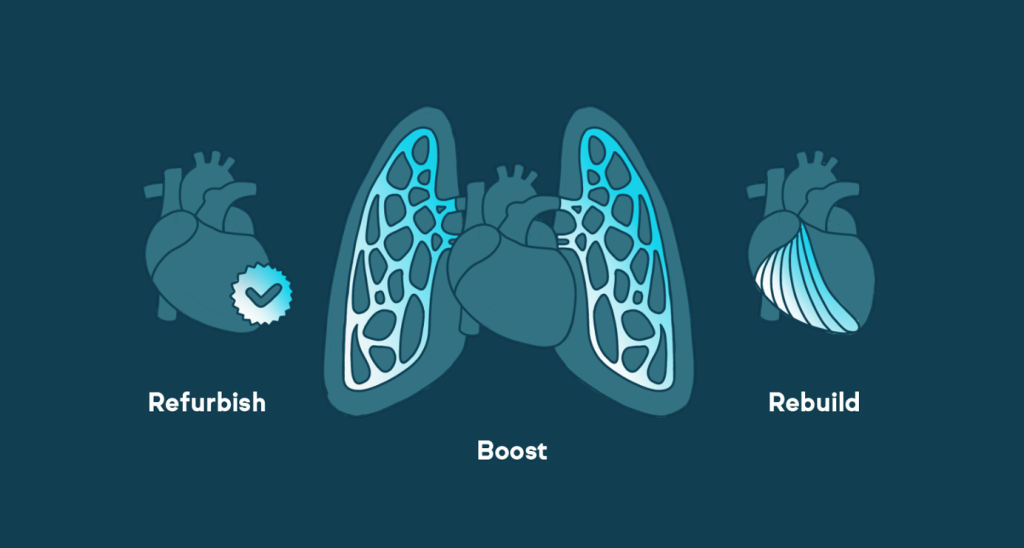
Building on what we’ve learned, HeartWorks is advancing a focused portfolio of therapies designed to go beyond support and toward rebuilding the heart. Each program targets a different limitation in today’s treatment landscape, with the goal of improving function, restoring tissue, and expanding long-term options for patients.
Using a patient’s own cells, these therapies are designed to generate new cardiac muscle and support remuscularization – moving beyond signaling-based support toward rebuilding what has been lost.
Bioengineered tissue approaches aim to provide structural and functional support for the heart, offering new possibilities for repairing or augmenting areas that cannot recover on their own.
Next-generation devices are being developed to improve circulation and reduce strain on the heart – creating new options for patients with complex physiology and limited treatment pathways.
The pathway to a cure is not only defined by the steps we take but by how quickly and effectively we can move between them.
Over time, HeartWorks has built the capabilities needed to accelerate this progress – moving from early feasibility studies to a more integrated, scalable model for innovation.
What once took years to advance is now supported by dedicated infrastructure, expanded clinical insight, and a growing network of patients, families, and partners.
More than a decade of clinical research has established a strong foundation in safety, delivery, and real-world application of cell-based therapies.
Each study has contributed critical insight – helping refine how therapies are developed, evaluated, and advanced toward future clinical use.
Long-term learning requires long-term connection. Through initiatives like The Co-op @ HeartWorks, patients and families play an ongoing role in shaping research – helping us better understand outcomes over time, identify future opportunities, and strengthen pathways to participation.
This connection ensures that what we learn continues to inform what comes next.
To support the next phase of innovation, HeartWorks is expanding its capabilities through the HEART Center—Health, Education, Access, Research, and Training.
This includes:
Training clinicians in minimally invasive and catheter-based delivery techniques
Advancing non-clinical studies to support therapy readiness
Creating environments for simulation, education, and collaboration
Together, these efforts help move therapies from concept to clinical application more efficiently and safely.
HeartWorks’ early work began within an academic environment – where foundational discoveries were made and the first patients were treated.
Today, as an independent, mission-driven organization, HeartWorks has the ability to move faster, scale more effectively, and focus resources on the therapies with the greatest long-term potential.
This shift reduces traditional barriers and accelerates the pathway from discovery to real-world impact.

Building on what we’ve learned, HeartWorks is advancing a focused portfolio of therapies designed to go beyond support – and toward rebuilding the heart.
Each program targets a different limitation in today’s treatment landscape, with the goal of improving function, restoring tissue, and expanding long-term options for people living with congenital heart disease.
Advancing these therapies requires more than scientific progress – it requires connection.
Because congenital heart disease is complex and highly individualized, identifying the right patients for future studies can be challenging. Progress depends on the ability to learn over time, understand long-term outcomes, and connect with individuals who may be eligible for future research.
That’s why participation matters.
Through initiatives like The Co-op @ HeartWorks, we are working to bring together patients, families, and researchers – helping ensure that future opportunities can be identified more efficiently, and that lived experience continues to shape what comes next.