
A Simple Guide to a Powerful Idea in Modern Medicine
Medicine has enetered a new era where doctors may be able to repair parts of the body using a patient’s own cells. One of the most promising tools helping make this possible is something called autologous stem cells.
While the term might sound complicated, the idea behind it is surprisingly simple.
Understanding Stem Cells
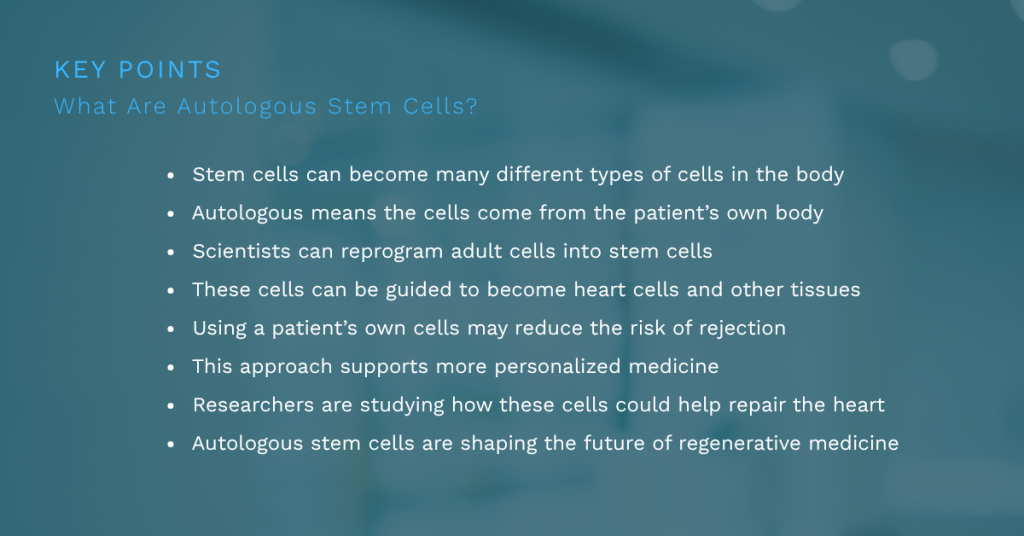
Stem cells are special cells in the body that have the ability to turn into different types of cells.
For example, some stem cells can become:
- Heart cells
- Muscle cells
- Brain cells
- Skin cells
- Blood cells
Because of this ability, scientists study stem cells to learn how the body grows, heals, and repairs itself.
Researchers hope that one day stem cells may help replace or repair damaged tissue caused by injury, disease, or conditions people are born with.
What Does “Autologous” Mean?
The word autologous simply means “from your own body.”
So autologous stem cells are stem cells that come from the same person who will receive them.
Instead of using cells from a donor, doctors collect a patient’s own cells and use them to help treat that same patient.
This approach can be very powerful because the body is less likely to reject its own cells.
How Scientists Create Autologous Stem Cells
In many types of research today, scientists begin with a small sample of a patient’s cells, often taken from skin or blood.
Those cells are then reprogrammed in the laboratory into something called induced pluripotent stem cells (iPSCs).
These stem cells behave much like early developmental cells in the body and can potentially become many different cell types.
Scientists can then guide these cells to become specific cells, such as:
- Heart muscle cells
- Nerve cells
- Liver cells
- Blood cells
This process allows researchers to study diseases and explore new ways to repair damaged tissues.
Why Autologous Stem Cells Are Important
Autologous stem cells have several advantages that make them especially exciting in medical research.
Lower Risk of Rejection
Because the cells come from the patient, the immune system is less likely to attack them.
Personalized Medicine
Treatments can be tailored to each individual person, since the cells carry that person’s genetic information.
Better Disease Research
Scientists can study how diseases affect a patient’s own cells, helping them better understand how conditions develop and how to treat them.
What This Could Mean for Heart Disease
Researchers studying heart disease (HeartWorks!) are particularly interested in stem cells because heart muscle has very limited ability to repair itself.
In the future, scientists hope autologous stem cells could help:
- Repair damaged heart muscle
- Strengthen weakened hearts
- Develop new therapies for congenital heart disease
- Create better models to test new treatments
The Future of Regenerative Medicine
Autologous stem cells are part of a growing field called regenerative medicine. This field focuses on helping the body repair, replace, or regenerate damaged tissues and organs.
Scientists around the world are working to safely translate these discoveries from the laboratory into real treatments that can improve patients’ lives.
Although many therapies are still in development, each new breakthrough brings researchers closer to a future where the body’s own cells may help heal the body itself.
A New Way of Thinking About Medicine
For generations, medicine has focused on treating symptoms or managing disease. Stem cell science introduces a different possibility: repairing the body at the cellular level.
Autologous stem cells represent an exciting step toward that future – where treatments may be built from the very cells that make us who we are.