
Every fifteen minutes, a family in the United States learns their child was born with congenital heart disease (CHD).
CHD is the most common birth defect, affecting nearly 1 in 100 babies. Advances in surgery and medical care over the past several decades have helped more children survive and grow into adulthood than ever before.
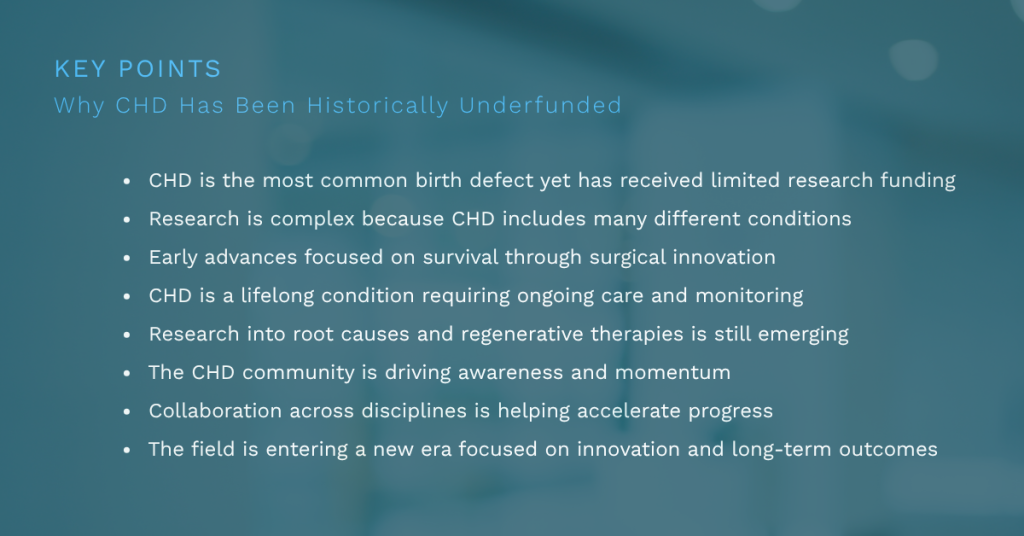
But despite its prevalence and lifelong impact, congenital heart disease has historically received less research attention and funding than many other major health conditions.
Understanding why helps illuminate why organizations, researchers, and families are working together to change the future of CHD care.
The Progress That Changed the Story
Fifty years ago, many children born with complex heart defects did not survive into adulthood. Thanks to incredible advances in pediatric heart surgery and medical care, survival has improved dramatically.
Today, there are more adults living with congenital heart disease than children. While this progress is remarkable, it also revealed a new reality: CHD is not cured by surgery. Most individuals with CHD require lifelong monitoring, multiple interventions, and specialized care as they grow. As survival improved, the focus of care expanded from saving lives in childhood to supporting health across an entire lifetime.
A Condition with Many Different Forms
One challenge in CHD research is that congenital heart disease is not a single condition.
Instead, it includes dozens of different heart defects, each with unique anatomy, treatment approaches, and long-term outcomes. Because of this complexity, research studies often involve smaller patient groups compared with more common conditions that have a single cause or presentation. This diversity has historically made large-scale research efforts more difficult.
A Field That Grew from Surgical Innovation
Many of the earliest breakthroughs in CHD care came from surgical innovation. Surgeons developed extraordinary procedures that allowed children with complex heart conditions to survive and thrive. While these surgical advances saved countless lives, the research landscape that followed focused heavily on clinical care and surgical techniques, rather than on the biological causes of CHD or regenerative therapies.
Only in recent years have advances in genetics, stem cell science, and regenerative medicine opened new possibilities for understanding and treating congenital heart disease at a deeper level.
The Lifelong Nature of CHD
Unlike some childhood conditions that resolve or can be cured, congenital heart disease is a lifelong condition. People born with CHD often face ongoing challenges, including:
- Additional surgeries or interventions
- Heart rhythm issues
- Heart failure risk
- The need for specialized adult congenital heart care
As the CHD population grows, so does the need for research focused on long-term outcomes and new treatment strategies.
The Power of the CHD Community
One of the most powerful forces changing the future of CHD research is the community itself. Families, patients, clinicians, researchers, and advocates are working together to accelerate progress. By sharing experiences, participating in research, and supporting innovation, the CHD community is helping researchers better understand the condition and identify new opportunities for treatment. Collaborative efforts between families and scientists are creating new pathways for discovery that did not exist before.
A New Era of Research and Innovation
Scientific tools available today are opening entirely new possibilities in congenital heart disease research. Researchers can now study heart cells in the laboratory, analyze genetic patterns, and explore regenerative approaches that were unimaginable only a few decades ago.
These advances are helping scientists investigate questions such as:
- Why congenital heart defects develop
- How heart cells function and repair themselves
- Whether regenerative therapies could help strengthen or repair the heart
While many discoveries are still in progress, the momentum in CHD research continues to grow.
How HeartWorks Is Helping Change the Future of CHD
While congenital heart disease has historically received less research attention than many other conditions, organizations like HeartWorks are working to help change that trajectory.
HeartWorks was created to accelerate progress by bringing together scientists, clinicians, engineers, and families in what we call a “Team of Teams.” This collaborative model recognizes that solving complex challenges like congenital heart disease requires expertise from many fields working toward a shared goal.
Through this approach, HeartWorks is helping advance new areas of research, including:
- Regenerative medicine that explores how heart cells may repair or strengthen damaged heart tissue
- Stem cell technologies that allow scientists to study heart cells derived from patients themselves
- Innovative medical devices designed specifically for congenital heart conditions
- Training and education programs that support clinicians caring for patients across their lifespan
Equally important, HeartWorks works alongside the CHD community itself. Families and individuals living with congenital heart disease bring invaluable insight that helps guide research priorities and future therapies.
Initiatives like The Co-op @ HeartWorks create opportunities for patients and families to contribute their experiences and help shape the next generation of CHD research.
By connecting science, medicine, and the lived experiences of heart families, HeartWorks is working to accelerate discovery and build a future where people born with congenital heart disease have more options, stronger hearts, and longer lives.